

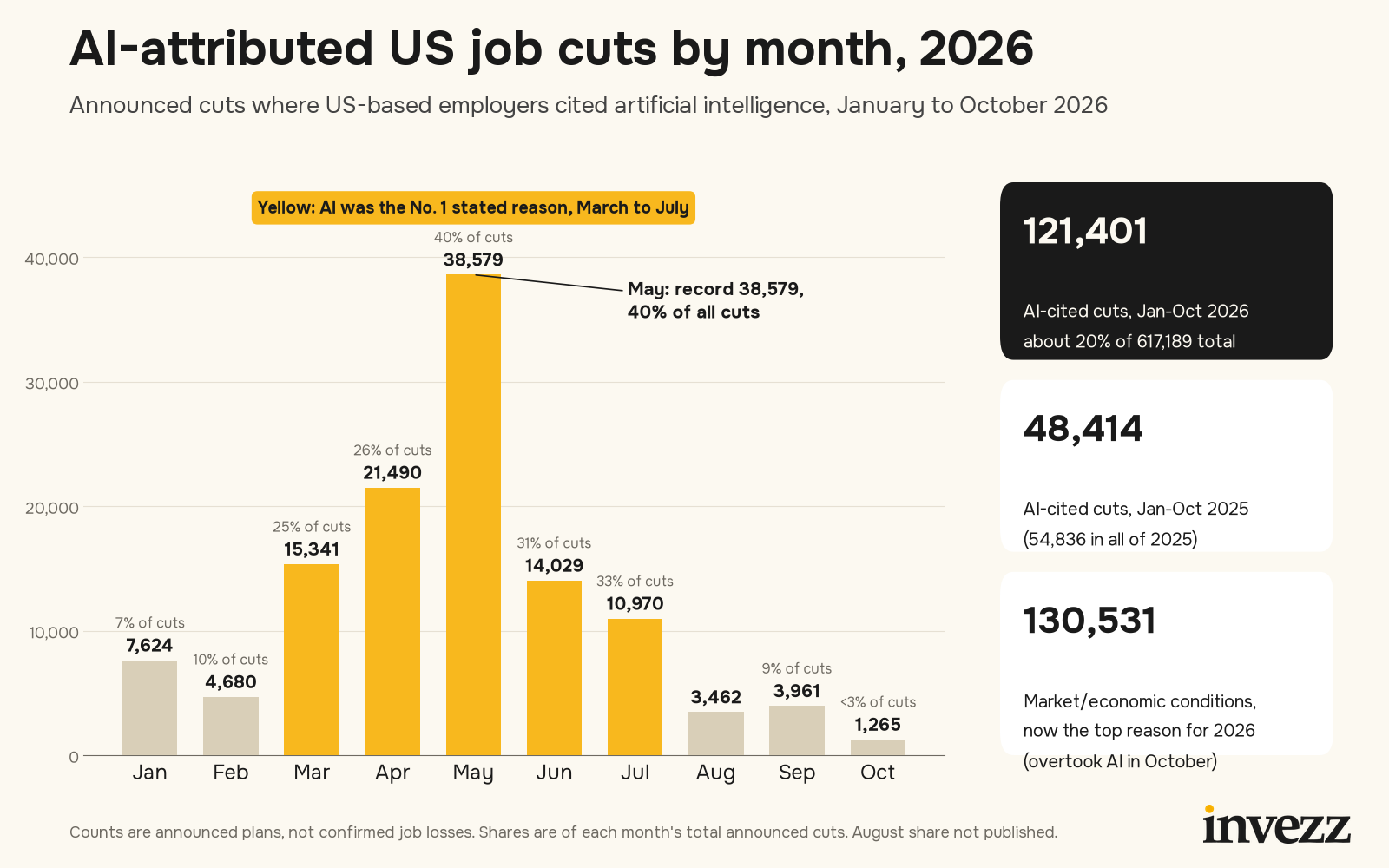
US employers have blamed artificial intelligence for 121,401 announced job cuts in the first 10 months of 2026, according to outplacement firm Challenger, Gray & Christmas, which puts the figure at about 20% of all announced US cuts.
That is two and a half times the 48,414 AI-attributed cuts Challenger logged in January to October 2025, and well above the 54,836 it recorded for the whole of last year.
AI peaked as the top reason in May, then faded
Challenger counts layoff plans that US-based employers announce and the reason they give, not people who actually lose work. Some plans are phased over years; some never happen.
On that basis, AI rose from 7,624 cuts in January, or 7% of the month’s total, to become the leading stated reason for five straight months from March to July.
May was the high point. Employers cited AI for 38,579 cuts, 40% of the month’s 97,006, the most since Challenger began tracking the reason in 2023.
Since August the reason has faded. October’s 1,265 AI-linked cuts were the lowest monthly total of the year and under 3% of all announcements, according to the firm’s report on November 5.
“The reasons employers give have shifted from technology to the economy,” said Andy Challenger, the firm’s chief revenue officer. Market and economic conditions, cited for 130,531 cuts, have now overtaken AI as the top reason for 2026.
Fewer stated AI cuts does not necessarily mean AI is replacing fewer jobs. In July, Challenger warned that regulation could make firms more careful, “which would make tracking the impact of AI on jobs more opaque.”
Technology companies did most of the cutting. The sector announced 171,501 cuts through October, up 21% on a year earlier and 28% of the national total.
The wider US labour market has not cracked. Nonfarm payrolls rose by 165,000 in October and the unemployment rate held at 4.1%, the Bureau of Labor Statistics said on November 6. The rate has stayed between 4.1% and 4.3% since March.
The information sector, home to software publishers and telecoms, is the weak spot, shedding an estimated 21,000 jobs in August and 11,000 in September before a flat October.
The companies that pinned cuts on AI
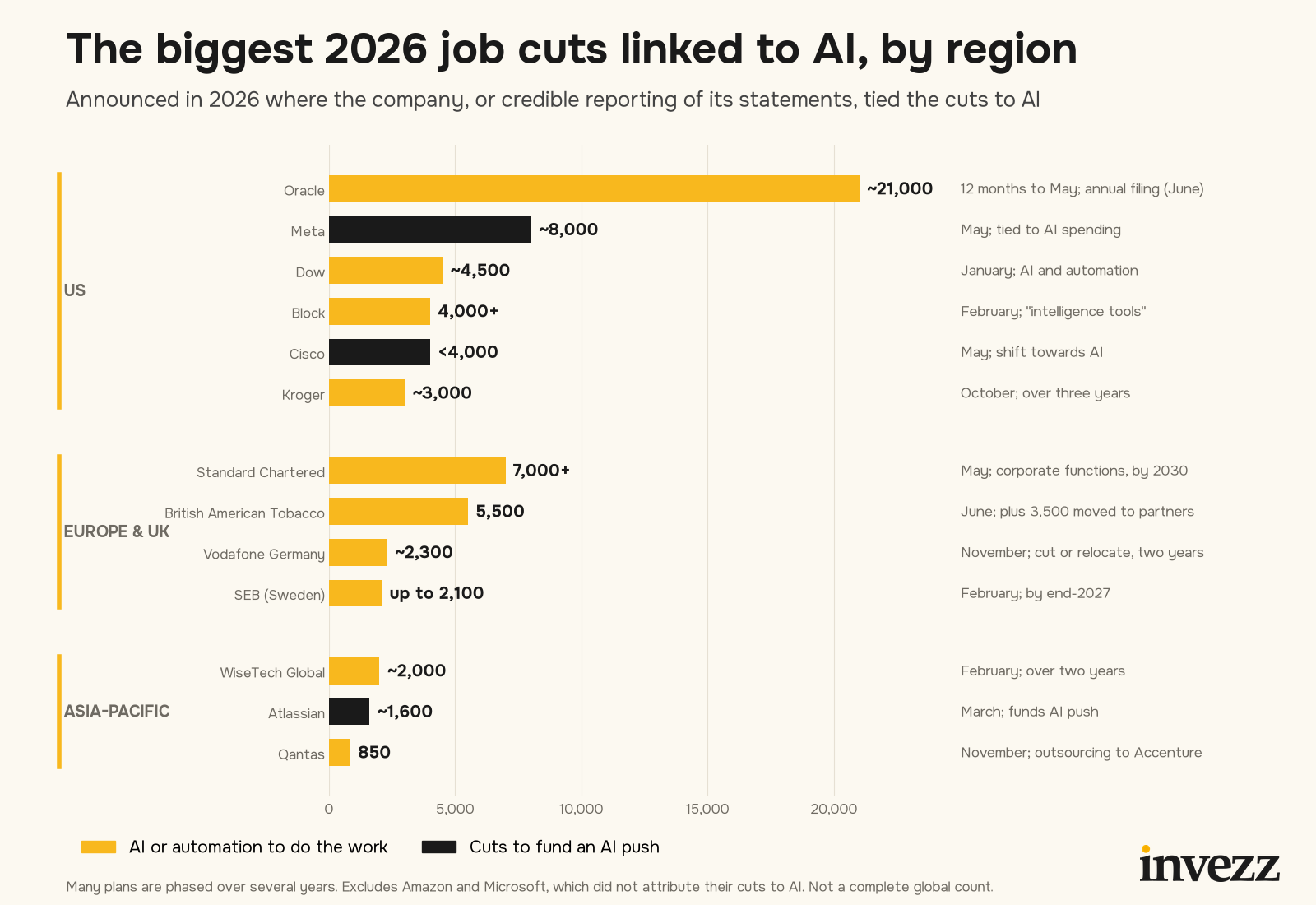
The largest single disclosure came from Oracle. Its annual filing in June showed headcount down by about 21,000, or 13%, over the year to May.
“The adoption and deployment of AI technologies across our operations have resulted, and may continue to result, in reductions to our workforce,” the company said in the filing, as reported by TechCrunch and CNBC.
At Block, Jack Dorsey cut more than 4,000 jobs in February, nearly half the workforce. He said the “intelligence tools” the company is building, paired with smaller teams, were changing how it runs.
Dow said in January it would cut about 4,500 roles, or 13% of staff, using AI and automation, while also forecasting weak revenue amid sluggish demand, Reuters reported.
Others framed cuts as funding AI rather than being replaced by it. Meta laid off about 8,000 people in May, roughly 10% of staff, and Mark Zuckerberg tied the move to the cost of AI spending, according to Reuters. Cisco cut fewer than 4,000 jobs in May while shifting investment towards AI.
Several high-profile cuts do not belong in an AI tally. Challenger said Amazon’s 16,000 corporate cuts in January looked more tied to over-hiring and management layers than to AI.
Microsoft said its 4,800 July cuts were “not being replaced by AI”. Its October voluntary exit offers to 60,000 staff are not in Challenger’s count.
Other plans are less firm. HSBC was reported by Bloomberg in March to be weighing deep cuts in an AI overhaul. Mizuho plans to remove work equivalent to up to 5,000 administrative jobs in Japan over 10 years, but intends to redeploy staff rather than lay them off.
Regions: a US-centric count, with Europe and Australia catching up
The best counts are American. No comparable tracker exists for Europe, Asia or emerging markets, so any global picture rests on company announcements.
In Europe and the UK, Standard Chartered said in May it would cut more than 15% of corporate-function roles by 2030, over 7,000 jobs. Chief executive Bill Winters spoke of replacing “lower-value human capital”, with back-office hubs in India, China, Malaysia and Poland most affected, Banking Dive reported.
British American Tobacco said in June that it would cut 5,500 roles outside the US and move 3,500 to partners including Accenture. Vodafone Germany said on November 9 that it would cut or relocate about 2,300 jobs over two years, partly through wider AI use in customer service.
Australia has become the sharpest flashpoint. WiseTech Global said in February it would cut about 2,000 jobs in an AI overhaul. Atlassian cut about 1,600 in March to redirect money to AI, and Qantas announced 850 cuts this week as it outsources back-office work to Accenture.
Unions have accused companies of “AI washing”, meaning using the technology as cover for offshoring, Reuters reported on November 12. The Reserve Bank of Australia has said AI has not yet caused widespread job losses, though it sees “tentative signs of adjustment”.
In India, the evidence is about slower hiring rather than AI-labelled layoffs. The top five IT services firms reduced net headcount by 6,981 in the year to March 2026, led by a 23,460 drop at TCS, Business Standard reported. Those firms also blamed weak client demand.
Jobs: entry-level, clerical and customer-facing roles
The clearest occupational signal comes from payroll data rather than layoff announcements.
The Canaries Dashboard, run by Stanford’s Digital Economy Lab with ADP Research, found employment in the most AI-exposed occupations fell 0.5% in the year to September, while the least-exposed roles grew 1.0%.
The gap is widest for young workers. Employment among 22- to 25-year-olds in highly exposed jobs fell 3.7%, the 36th straight month of annual decline. The researchers single out software developers and customer service representatives, where early-career headcount has fallen while older colleagues’ jobs have grown.
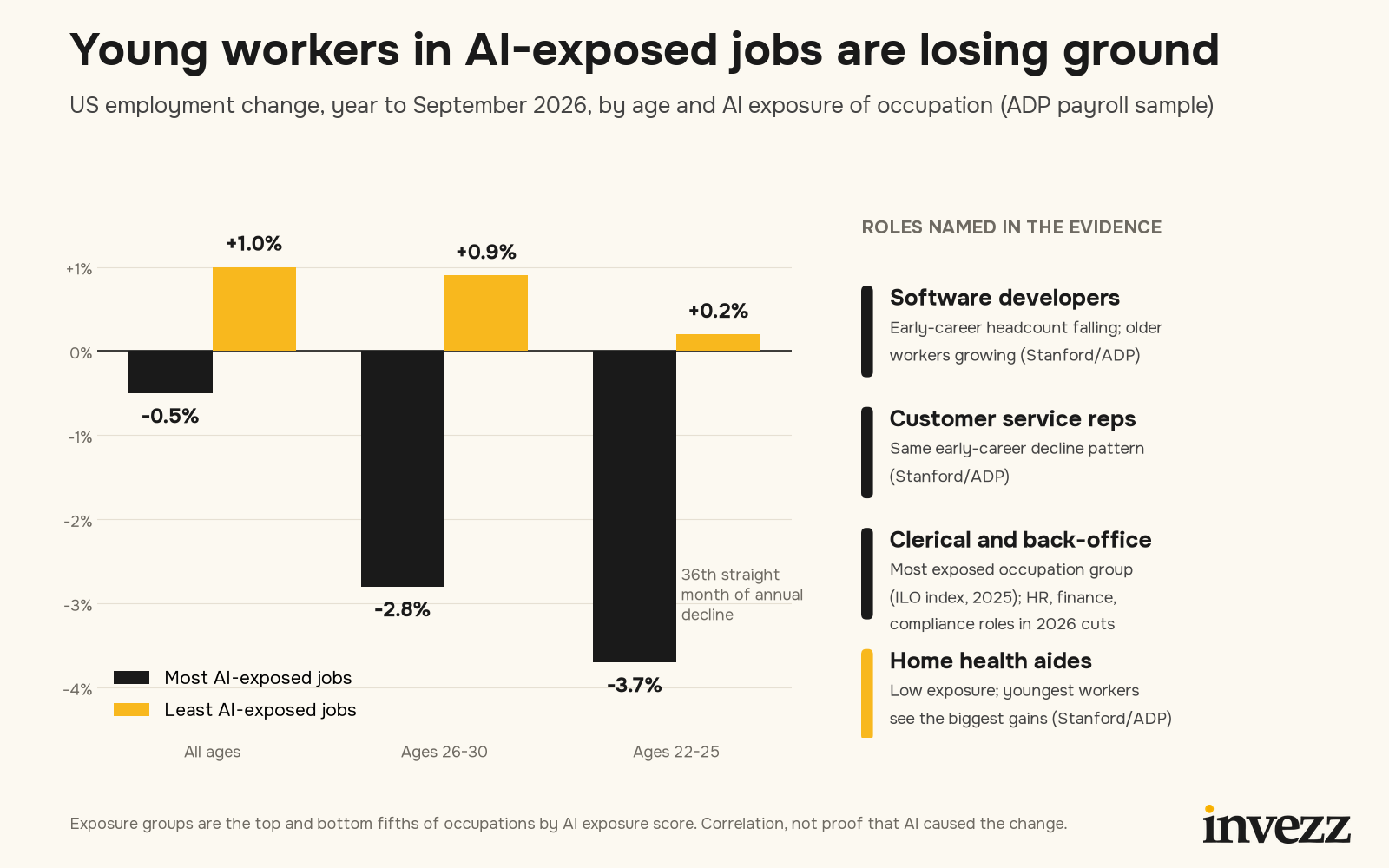
The International Labour Organization’s refined exposure index, published in 2025, ranks clerical work as the occupation most exposed to generative AI. The 2026 announcements fit: the roles named include back-office finance, procurement, HR, compliance and customer support.
Women are more exposed. The Stanford team found 43.8% of women in its sample work in the most-exposed group of occupations, against 32.4% of men.
The hiring on the other side of the ledger
AI is also creating jobs, although rarely the same ones it is cutting. Data-centre job postings in the US have more than doubled in two years to about 6 in every 1,000 listings, while total postings fell about 12%, according to Indeed Hiring Lab in July.
About a quarter are for installation and maintenance workers, who typically earn less than the software staff being cut.
That hiring does not offset documented losses for the people affected, but it helps explain why AI-linked layoffs have not yet shown up in the headline unemployment rate.
The next test is Challenger’s November report on December 3, followed by the BLS November jobs data on December 4.
AI disclosure: AI tools assisted with research and drafting of this piece. An Invezz editor reviewed the facts, sources and wording before publication. Any opinions or analysis are Invezz’s, not those of an automated system.
The post AI layoffs in 2026 so far: 121,401 US job cuts, and the firms, jobs and regions hit appeared first on Invezz
US employers have blamed artificial intelligence for 121,401 announced job cuts in the first 10 months of 2026, according to outplacement firm Challenger, Gray & Christmas, which puts the figure at about 20% of all announced US cuts. That is two and a half times the 48,414 AI-attributed cuts Challenger logged in January to October 2025, and well above the 54,836 it recorded for the whole of last year. AI-attributed US job cuts by month, January to October 2026. Announced plans by US-based employers, not confirmed job losses | Source: Challenger, Gray & Christmas monthly job cuts reports AI peaked as the top reason in May, then faded Challenger counts layoff plans that US-based employers announce and the reason they…
Leave a Reply